‘Mini Brains’ Are Reshaping Research — but They’re Not Replacing Lab Animals Yet
‘Mini Brains’ Are Reshaping Research — but They’re Not Replacing Lab Animals Yet
Few research tools have captured the public imagination quite like “mini brains”.
The phrase suggests something almost futuristic: tiny brain-like structures grown in the laboratory, capable of helping scientists understand human disease in ways that animals cannot. In one sense, that excitement is justified. Brain organoids have rapidly become one of the most intriguing developments in biomedical science, especially for studying disorders rooted in human brain development and function.
But the stronger claim — that organoids are about to replace animal research altogether — goes too far.
The current evidence points to something more subtle and arguably more important. Brain organoids and other advanced human in vitro systems are becoming powerful complements to animal models. They can reveal disease mechanisms that animals often miss, particularly when the biology in question is deeply human-specific. They may reduce some animal use and replace certain kinds of experiments. But they are not yet capable of taking over the full role of animal research.
That distinction is not a disappointment. It is the real story.
What a brain organoid actually is
A brain organoid is not a tiny functioning brain in the everyday sense. It does not think, feel, perceive or reproduce the complexity of a human nervous system. But it is far more than a standard dish of cells.
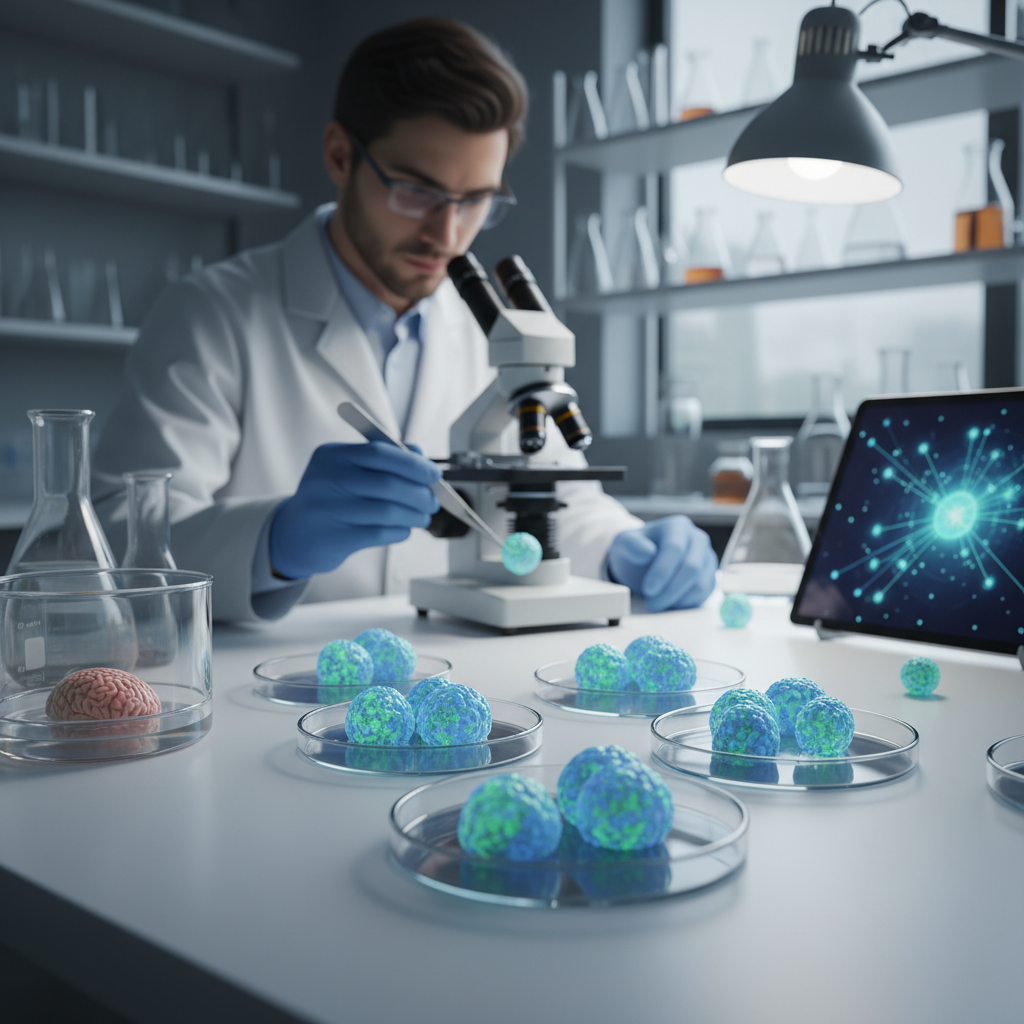
Organoids are three-dimensional structures grown from stem cells that self-organise into tissue-like arrangements. In the case of cerebral organoids, that means they can reproduce aspects of early human brain development, including certain cell types, organisational patterns and developmental dynamics.
That makes them scientifically valuable because they occupy an intermediate space between two older systems. They are much more biologically complex than conventional flat cell culture. But they are also much simpler than a living animal.
This in-between position is precisely what gives them their strength. One of the most relevant reviews in the supplied literature argues that human cerebral organoids can bridge an important gap between patient studies and animal models, especially for human-specific aspects of neurodevelopment and neurological disease.
Why animal models still leave important gaps
Animal research remains a central part of biomedical science for good reason. Animals allow scientists to study disease in a whole organism, with circulation, immune response, metabolism, hormonal systems and behaviour all interacting at once.
That level of integration remains crucial, particularly when testing safety, whole-body effects or systemic biology.
But there is also a long-recognised limitation: animals are not humans. And nowhere is that difference more important than in the brain.
The human brain develops differently, matures differently and, in many respects, behaves differently from the brains of common laboratory animals. Some features of human neurodevelopment and neurological disease are therefore difficult to model accurately in mice or other species.
That is where brain organoids become especially useful. They give researchers access to human tissue biology in a format that is more structured and developmentally relevant than ordinary cell culture, while avoiding some of the species mismatch that comes with animal models.
For certain questions, that is a major advance.
Where organoids have already proved their worth
The supplied literature supports the use of cerebral organoids in modelling conditions such as microcephaly, Zika-related brain injury, Alzheimer’s disease and other neurodevelopmental and neurodegenerative disorders.
These are exactly the kinds of conditions where human-specific biology matters. In the case of Zika, for example, organoids became particularly important because they helped researchers observe how the virus could disrupt developing human brain tissue in ways that conventional models could only approximate.
That was not merely a technical novelty. It showed that organoids could answer a biologically important question with a level of human relevance that had been difficult to achieve before.
In the context of neurodegenerative disease, organoids are also being used to study protein aggregation, cell vulnerability and early disease mechanisms in a more human setting. They do not recreate the full disease of a living person, but they can reveal parts of the process that other model systems fail to show clearly.
Part of a broader shift in biomedical research
Brain organoids are only one part of a larger scientific movement.
A broader review of complex in vitro disease models supports the idea that organoids and related platforms help bridge the gap between simple cell culture and animal models for studying disease mechanisms and testing treatments. Another review in reproductive bioengineering reinforces the same trend, pointing to organoids and other advanced human in vitro systems as increasingly important tools in toxicology, drug testing and mechanistic research.
This wider context matters because it shows that organoids are not just a neuroscience curiosity. They are part of a broader rethinking of how research models should work.
Scientists are not merely looking for replacements. They are looking for model systems that fit specific biological questions more precisely.
What organoids do especially well
The greatest strength of brain organoids is human relevance.
They allow researchers to ask questions about human tissue in ways that ordinary cell culture cannot. That can be especially valuable for:
- modelling human-specific aspects of early brain development,
- studying disease mechanisms that do not translate well across species,
- investigating how human neural tissue responds to infection or toxic insult,
- and screening therapeutic ideas in a system that is more realistic than standard cultured cells.
Organoids can also help researchers decide which experiments are worth pursuing in more complex systems. In that sense, they may refine animal research even when they do not replace it.
That is one reason their impact may ultimately be larger than it first appears. A tool does not need to do everything to change a field. It only needs to do some things significantly better.
Why they still fall short of full replacement
For all their promise, organoids have major limitations.
The evidence supplied is explicit on this point. Brain organoids still suffer from incomplete maturation, limited vascularisation, simplified cell-type composition and variability between models. They do not fully reproduce the complexity of a developed human brain, still less the entire body environment in which real disease unfolds.
That matters enormously. A brain organoid cannot model behaviour. It cannot reproduce full immune interactions, systemic metabolism, blood flow in any realistic sense or the multi-organ effects that many therapies may trigger.
This means there are still many questions for which animal research remains essential.
Success in modelling disease in an organoid also does not automatically translate into better clinical prediction. Nor does it guarantee regulatory acceptance in drug development or toxicology settings. The path from a useful research tool to a trusted clinical or regulatory platform is long.
So while organoids can replace some experiments in some contexts, the evidence does not support the idea that they can currently replace animal research in general.
Why “partial replacement” may be the real breakthrough
Public discussion often treats this issue as a simple contest: will mini brains replace lab animals, yes or no?
That framing misses the most meaningful part of the story.
The current scientific reality is that organoids can help reduce some animal use, refine when animal studies are needed, and improve the biological relevance of early-stage research. That may not sound as dramatic as total replacement, but it could be far more consequential in practice.
If researchers can ask sharper questions in more human-like systems before moving to animal models, they may be able to design better studies, avoid weaker hypotheses and improve the overall quality of preclinical science.
Ethically, that matters. Scientifically, it matters just as much.
What this could mean for patients eventually
For patients, the benefits are unlikely to be immediate in the way a new medicine or diagnostic test would be. The impact of organoids is upstream.
If they help scientists understand disease mechanisms more accurately, they may improve the quality of drug development, reveal therapeutic targets that were previously missed and reduce the number of false starts caused by poor model choice.
That is especially relevant in neurology, where treatment development has often struggled with the gap between animal results and human disease.
If organoids help close even part of that gap, they may quietly influence the quality of therapies that reach patients later.
The challenge ahead
The future of brain organoids depends on two parallel developments.
First, the technology itself needs to improve. Researchers will need organoids that are more mature, more reproducible, more vascularised and more representative of real tissue complexity.
Second, the scientific community will need to become more precise about where organoids are genuinely superior, where they are merely helpful, and where they remain insufficient.
That is how serious research tools find their place: not through hype, but through careful matching of method to question.
The bottom line
Brain organoids are already changing how scientists study disease. They offer a more human-relevant experimental system for certain questions, especially in neurodevelopment and neurological disease, and they can help reduce or refine some animal use.
But they are not ready to replace lab animals outright. Their biological limitations remain too significant, and many important research questions still require whole-organism models.
The most honest conclusion is therefore the most useful one: mini brains are not ending animal research, but they are helping reshape it. And in modern biomedicine, that may prove to be the more important revolution.